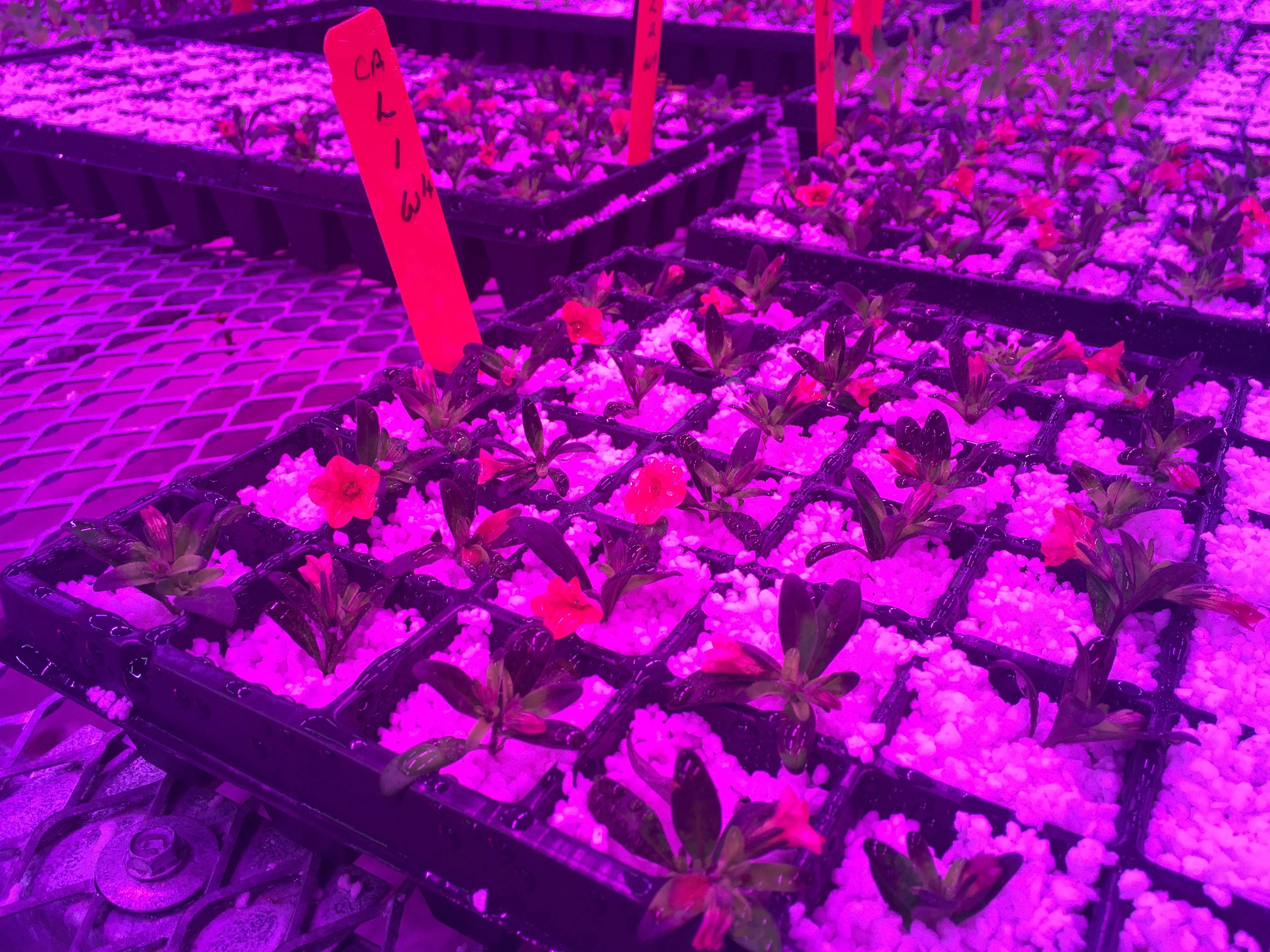
Deciding if LEDs are the right fit for an operation can be a difficult decision for growers to make. There are a number of factors to consider, including cost, the growing environment and the size of any trials. To help growers make an informed decision, Dr. Abhay Thosar, senior plant specialist at Philips Lighting, offers three tips for growers considering trialing LEDs for propagation.
1. Start small and build up
Thosar says growers need to look at their geographic location when first considering LEDs. Where a grower is based determines how much natural light is available at different points in the year, and consequently, how much supplemental lighting is needed.
“Most propagation happens from the end of December until March or April for sales into Easter and Mother’s Day,” Thosar says. “When the propagation happens – whether it’s in Michigan or the Pacific Northwest – we see a lot of dark growing days.”
In order to have a viable, informative trial, Thosar says a minimum 1,500 square feet of growing space should be used. He says this gives the grower a large enough sample size to evaluate.
2. Expect a return on investment
Many growers believe that LEDs are expensive, and as a result, not economically viable. But Thosar notes that isn’t true.
In his experience, LEDs offer more robust growth, earlier flowering and a faster finish than other growing options such as high-pressure sodium (HPS) lighting or when no supplemental lighting is used. Plugs have also been shown to fill faster, he says. There is also no bulb replacement with LEDs like there is with HPS every two to three years. So, while there could be a cost associated with trialing LEDs, there are built-in savings.
“The payback [for LEDs] falls anywhere from 1.5 to four years,” Thosar adds.
3. Picture the power of the spectrum
According to Thosar, the spectrum of LEDs is the light’s biggest advantage over other methods. Unlike HPS lights – which, according to Thosar, were originally developed to light parking lots – LEDs were designed for what he calls “the plant eye.” In short, this means LEDs are better able to impact plants than HPS.
“The spectrum for high pressure sodium was for the human eye – so humans could see clearly,” Thosar says.
Additionally, Thosar says LEDs use less electricity than HPS bulbs and do not give off excess heat that can affect a growing space.
“That helps you run a cooler environment in the greenhouse,” he says.
In time, once more research is done, growers will be able to pinpoint which part of the spectrum is best for each plant in their greenhouses. But even now, an impact can be seen.
Photo: Karen E. Varga
Latest from Greenhouse Management
- Millennium Pacific Greenhouses launches California Grown Cucumber Program
- Scientists develop vitamin A-enriched tomato to fight global deficiency
- Tennessee Green Industry Field Day scheduled for June 11
- UTIA and UT Knoxville research teams will develop automated compost monitoring system
- Ken and Deena Altman receive American Floral Endowment Ambassador Award
- [SNEAK PEEK] Leading Women of Horticulture: The women of Fairview Greenhouses & Garden Center
- [SNEAK PEEK] Leading Women of Horticulture: The inventive women of TPIE ’26
- Growing successful spring crops with Topflor