.jpg)
From The Nation: Food security - a nation's ability to provide enough food for its population without being overly reliant on outside nations - is becoming an important issue for many countries around the world.
It is a particular concern in the UAE, where the hot, dry climate and the shortage of water make growing any crops an expensive, difficult and resource-intensive endeavor.
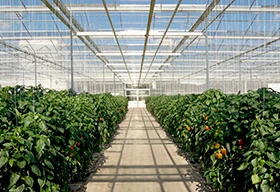
A research project at the Masdar Institute hopes to help address that by developing a unique greenhouse that is self-sufficient for energy and irrigation water.
In cold climates, greenhouses are used to keep plants warm. But in hot climates, they can cause the plants to die. Air-conditioned greenhouses are extremely expensive to run and environmentally unfriendly.
This project aims to integrate the latest in solar energy, desalination, and engineering systems and management to design a greenhouse that does not take electricity or water from the UAE's utilities.
Instead, using transparent photovoltaic panels on the roof, the wholly self-sufficient stand-alone greenhouse would be able to use solar-generated electricity to produce irrigating water and to regulate the temperature, humidity and air velocity, while allowing in sunlight for photosynthesis. The recovered thermal and electrical energy would be used to desalinate seawater or brackish groundwater using membrane technology, as well as collecting water from the air through a humidification/dehumidification system.
Click here to continue reading.
Latest from Greenhouse Management
- Jackson & Perkins expands into Canadian market
- Green & Growin’ 26 brings together North Carolina’s green industry for education, connection and growth
- Marion Ag Service announces return of Doug Grott as chief operating officer
- Cincinnati Zoo & Botanical Garden debuting new perennial section at 2026 Breeder Showcase
- The Garden Conservancy hosting Open Days 2026
- Registration open for 2026 Perennial Plant Association National Symposium
- Resource Innovation Institute and North Dakota State University explore co-location of data center and greenhouses
- Fred C. Gloeckner Foundation Research Fund calls for 2026 research proposals