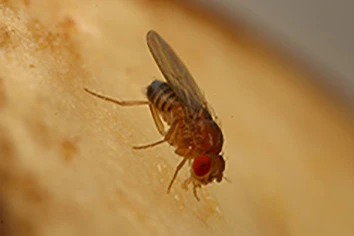
A research team at the University of California, Riverside, has discovered how the common fruit fly's taste receptors detect sweet compounds, a discovery that could lead to new strategies for repelling plant damaging insects. .jpg)
According to the university, the fly is a powerful model organism for studying animal development and behavior. Understanding the mechanisms by which it tastes and ingests sweet substances may offer tools to control insect feeding.
Insect receptors were discovered decades ago but it wasn't until now that researchers understood how the receptors functioned. The study could hold relevance for a number of insects including disease spreading mosquitoes and crop damaging beetles and weevils.
Fruit flies have eight sweet taste receptors. Researchers found that each of the eight receptors confers sensitivity to one or more of the sweet substances they tested in the lab. Their systematic analysis showed that the receptors could be separated into two groups based on which compounds they detect and how closely related they are in sequence.
The team's results were published online in the "Proceedings of the National Academy of Sciences." For more information on the team's research visit the University of California, Riverside, website.
Photo: D-H Choe Lab, UC Riverside.
Latest from Greenhouse Management
- The Growth Industry Episode 10: State of the Horticulture Industry
- Millennium Pacific Greenhouses launches California Grown Cucumber Program
- Scientists develop vitamin A-enriched tomato to fight global deficiency
- Tennessee Green Industry Field Day scheduled for June 11
- UTIA and UT Knoxville research teams will develop automated compost monitoring system
- Ken and Deena Altman receive American Floral Endowment Ambassador Award
- [SNEAK PEEK] Leading Women of Horticulture: The women of Fairview Greenhouses & Garden Center
- [SNEAK PEEK] Leading Women of Horticulture: The inventive women of TPIE ’26