Check your horticultural lighting knowledge with these terms from our 2016 State of Lighting Report published in the July 2016 issue of Greenhouse Management.
1. Daily Light Integral (DLI): the cumulative amount of Photosynthetically Active Radiation (PAR) light received each day
2. Day-extension lighting: the practice of delivering light to extend the length of the natural day
3. Haitz’s Law: states that the amount of light coming out of a light-emitting diode (LED) will increase 20 times in the next 10 years (not to be confused with efficiency), and that the cost per diode will decrease 10 times in the next 10 years (Haitz and Tsao, 2011).
4. Horticultural Electrical Efficiency (HAR): the ratio of electrical power that is converted to photons of light (micromoles per second: µmol·m–2·s–1) in the PAR spectrum. In other words, it is measured by how many µmol a particular fixture emits every second (s) per every Watt (W) of electrical power provided. This number is either provided or can be directly calculated from the manufacturer fixture specifications.
5. Intensity: the rate at which light energy is delivered to a unit of surface, or energy per unit time per unit area
6. Light: radiation within the electromagnetic spectrum that has both wave and particle properties
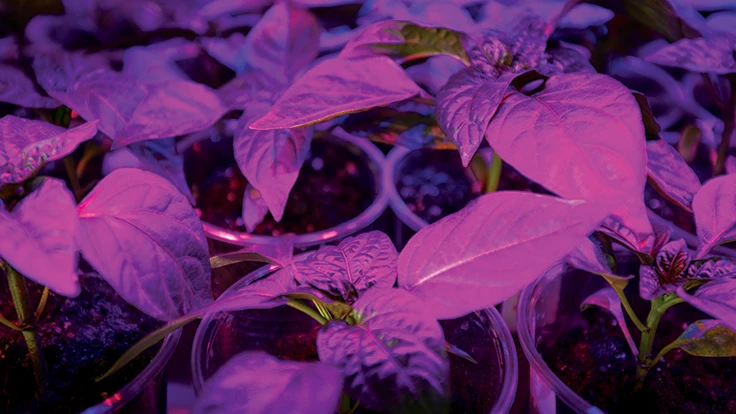
7. Light spectrum: the frequency or wavelength of light. Different spectra or colors play different roles in plant development; red and blue play an important role in photosynthesis, and red and far-red in flowering and stem elongation.
8. Night-interruption lighting: the practice of providing light to plants during the middle of the night so that plants will perceive a short night/long day instead
9. Photons: individual particles of light
10. Photoperiod: the period of time in 24 hours that plants are exposed to light
11. Photoperiodic lighting: the use of electrical lighting to alter the daylength in order to affect plant growth and development; may be provided with day-extension or night-interruption lighting
12. Photoperiodism: a biological response to a change in the proportions of light and dark in a 24-hour daily cycle. Plant responses such as flowering can be classified as: short day (requires daylengths equal than or shorter than a certain critical daylength to flower); long day (requires daylengths equal than or longer than a certain critical daylength to flower); or day neutral (flowering is not affected by daylength).
13. Photosynthetically Active Radiation (PAR) light: wavelengths that are used for photosynthesis (400-700 nanometers)
14. Sole-source lighting: the use of electrical lighting as a complete replacement of ambient light
15. Supplemental lighting: the use of electrical lighting to add to available ambient light for quicker or better plant growth

See how growers are using horticultural lighting, along with the latest LED lighting research in Greenhouse Management's "2016 State of Lighting Report."
Sponsored by:

Sources: Christopher J. Currey; Philips Lighting; “Supplemental Light” by J. Raymond Kessler, Jr., accessed at www.ag.auburn.edu/landscape/supplementallight.html; “Luminous possibilities” by Ricardo Hernandez, April 2016 issue of Greenhouse Management; “Lighting Systems” accessed athttps://courses.cit.cornell.edu/hort494/greenhouse/lighting/lightlft.html; “What are short day and long day plants?” accessed at http://extension.oregonstate.edu/gardening/what-are-short-day-and-long-day-plants; “Managing Photoperiod in the Greenhouse,” by Christopher J. Currey, Roberto G. Lopez, Erik S. Runkle, accessed at https://www.extension.purdue.edu/extmedia/HO/HO-253-W.pdf
Latest from Greenhouse Management
- The Growth Industry Episode 10: State of the Horticulture Industry
- Millennium Pacific Greenhouses launches California Grown Cucumber Program
- Scientists develop vitamin A-enriched tomato to fight global deficiency
- Tennessee Green Industry Field Day scheduled for June 11
- UTIA and UT Knoxville research teams will develop automated compost monitoring system
- Ken and Deena Altman receive American Floral Endowment Ambassador Award
- [SNEAK PEEK] Leading Women of Horticulture: The women of Fairview Greenhouses & Garden Center
- [SNEAK PEEK] Leading Women of Horticulture: The inventive women of TPIE ’26