Photo courtesy of WUR
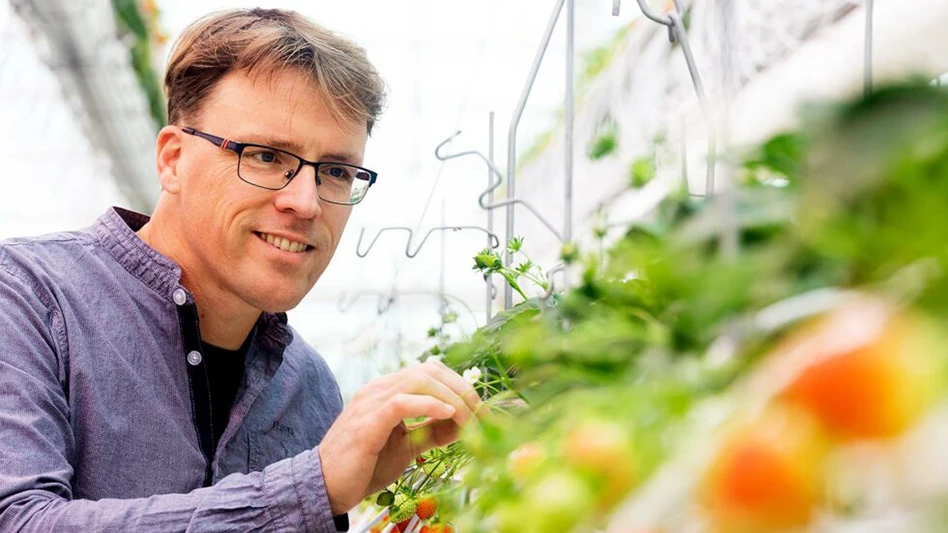
Earlier this year, Gerben Messelink, Ph.D., was reappointed as special professor of resilient cropping systems with biological pest control in greenhouse horticulture within the entomology chair group led by Bregje Wertheim, Ph.D., at Wageningen University & Research in the Netherlands.
The 5-year extension of his professorship is co-funded by Biobest, a biocontrol company part of BioFirst Group. It is also supported by Interpolis via Innovatiefonds Hagelunie, a horticultural insurer and innovation and impact fund for plant-based crops.
"We believe it is vital to support biological crop protection from a scientific and educational perspective through a renowned institution like WUR," said Felix Wäckers, global R&D director at Biobest. “Our collaboration will generate new insights and foster more pesticide-free solutions that benefit both growers and the environment.”
“Greenhouse horticulture is moving toward an emission-free future built on biological ecosystems,” said Jaap Breugem, manager of Interpolis and director of the Innovatiefonds Hagelunie. “By replacing chemicals with natural enemies, we promote sustainable and innovative cultivation. Investing in knowledge helps both growers and the environment, a transformation we’re proud to support.”
Messelink contributes to the field of biological control agents. His work has helped introduce several biological control agents to the market. His research into preventive use and long-term establishment of natural enemies has helped develop resilient cultivation systems.
Messelink is also active internationally in biological control through participation in European research projects and the establishment of biological control programs in Asia and Africa. He also serves as convenor of the Greenhouse Working Group for the International Organisation for Biological and Integrated Control.
At WUR, Messelink will further focus on research to develop preventive biocontrol strategies (the standing army approach) with the aim to further build resilient greenhouse cultivation systems.
This includes studying the complexity of controlling multiple and increasingly invasive pests, the functional diversity of natural enemies (team building), and developing tools to support long-term establishment of natural enemies through supplemental food, service plants, shelter and diverse habitats.
His goal as a professor is to strengthen the connection between fundamental ecological research and applied research in biological control.
“With the growing challenges of pest resistance and the influx of invasive species, our work is far from done,” Messelink said. “I am grateful to WUR, Biobest and Innovatiefonds Hagelunie/Interpolis for enabling the extended professorship and look forward to bringing students, academics and industry together in combining the best of augmentative and conservation biocontrol.”
Latest from Greenhouse Management
- Blue Grass Farms acquires Brehob Nursery
- OHP expands sales team with new hire and internal promotion
- Seed Your Future aims to double 2025 total for 'Round-Up at the Register' 2026 campaign
- Beacon Impatiens partners with Roots for Youth in 2026
- Inner visions
- New internship data empowers horticulture employers
- American Horticultural Society announces winners of 2026 Great American Gardeners Awards
- Sustainabloom releases new sustainability template for wholesale florists